A practical command framework for deciding, communicating and verifying partial, phased and full event evacuation without turning a safety plan into a telephone chain.
An evacuation plan can describe routes, alarms and assembly areas yet still leave the hardest operational question unanswered: who is authorised to change the movement strategy when conditions change? At a live event, an ambiguous decision path can delay action, create competing instructions or move people toward a new hazard.
This guide treats evacuation authority as a command system. It does not prescribe one universal strategy. The correct response depends on the event, hazard, venue design, crowd profile, fire-risk assessment, local law and advice from competent safety and emergency professionals.
What is event evacuation decision authority?
Event evacuation decision authority is the documented allocation of who may initiate, widen, narrow, pause or end protective movement, what evidence informs that choice, who communicates it and how execution is verified.
The UK Health and Safety Executive says emergency plans should identify competent people to take control, key roles such as an incident controller, and arrangements for training and realistic practice. UK fire-safety guidance for events also expects organisers to determine responsibilities, escape arrangements, warning methods and what happens after people leave. These principles support a clear authority model; they do not make this article a substitute for jurisdiction-specific advice.
The strategy name matters less than whether one accountable command function can turn changing evidence into one coherent instruction.
Partial, phased and full evacuation are different operating choices
A partial evacuation moves people from an affected zone while other areas remain in place or continue under restrictions. A phased evacuation moves defined groups in a controlled sequence. A full evacuation directs everyone in scope toward places of safety. Other protective actions—including invacuation, lockdown or shelter—may be appropriate for some threats, but must not be confused with the fire strategy.
| Strategy | Useful when | Authority must confirm | Main coordination risk |
|---|---|---|---|
| Partial | A hazard is contained and safe separation is credible | Boundaries, destination, route capacity and escalation trigger | Unaffected zones receive the partial message and move unnecessarily |
| Phased | Sequencing reduces route conflict or reflects the assessed venue strategy | Phase order, release trigger, route status and exceptions | Teams improvise the sequence or send incompatible instructions |
| Full | The hazard or uncertainty requires movement across the defined scope | All-zone warning, usable exits, accessible assistance and accounting | A single generic message ignores blocked routes or differing needs |
The UK Home Office open-air event guide applies in England and places the emergency plan inside the fire-risk-assessment process. The HSE emergency-procedures guidance stresses agreed responsibilities, competent control, training and coordination. Use the applicable rules where the event occurs.
Build the Authority-to-Action chain
The WENOTIFT Authority-to-Action chain connects six jobs: detect, assess, decide, communicate, execute and verify. Every job needs a named primary role, a deputy and a fallback channel.
Put one role at the decision point
The event command plan should name the role—not merely a person's name—that holds operational decision authority during each event phase. It should also state when statutory authorities or emergency services assume or direct command under local arrangements.
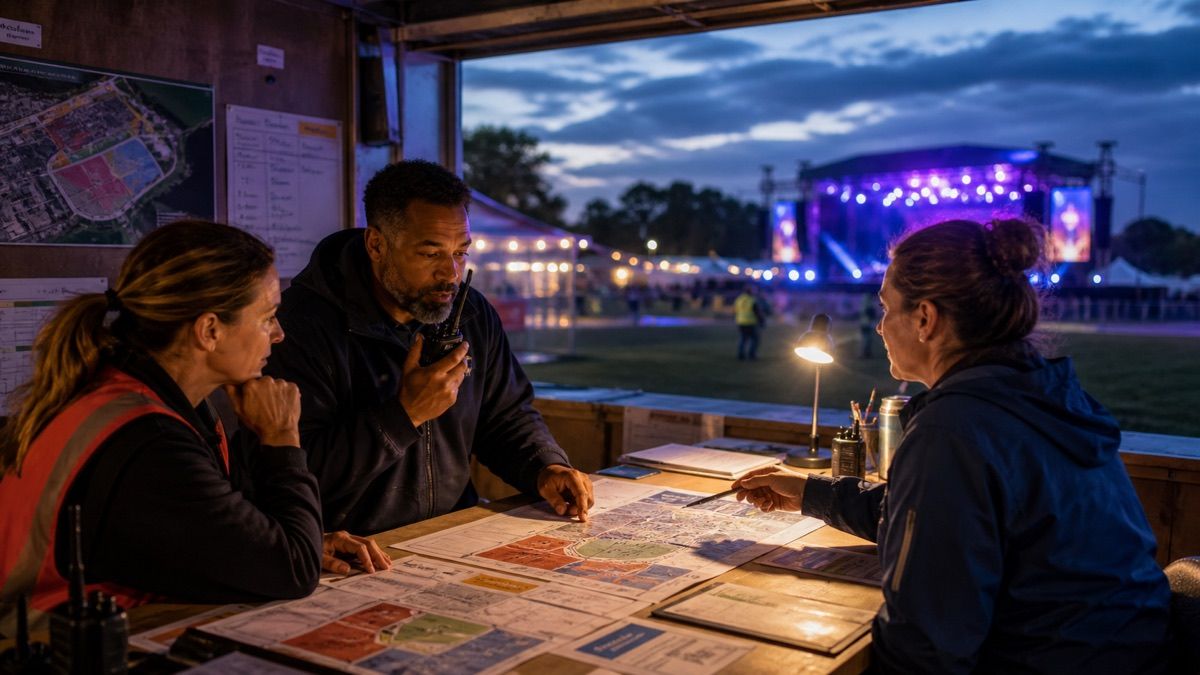
That authority cannot work alone. A useful decision cell may include event control, venue safety, security, medical, production, accessibility and communications leads. Specialists provide evidence and consequences; the authorised commander resolves the instruction. The deputy takes over under a defined rule, not an informal absence.
Avoid a chain where every stakeholder must approve urgent protective action. Commercial, artist or sponsor representatives may need notification, but life-safety decisions should not wait for brand consensus.
Define decision inputs before doors open
Do not reduce a complex event to one universal numeric trigger. Instead, predefine the evidence the commander needs:
- hazard location, direction and credible worst case;
- people exposed now and under likely development;
- route, exit, refuge and assembly-area status;
- crowd density and counterflow risk;
- assistance requests and available trained teams;
- weather, transport, perimeter and off-site conditions;
- reliability of alarms, public address, screens, radio and backup channels;
- advice or instruction from emergency services and public authorities.
Record which conditions require immediate action, which prompt escalation and which allow a monitored hold. A trigger should always identify its source and the authorised response—not only a colour on a dashboard.
Separate the decision message from the public message
The command record needs scope, rationale, time, authoriser, routes, exceptions and review point. The public instruction should be shorter: what is happening, who must act, where to go, what not to do and where updates will appear.
Prepare message variants for zones, languages and formats. Staff briefings, radio calls, public address, text alerts, screens and accessible channels should express the same action. If the public message changes, retract or supersede the old instruction explicitly.
Make route verification part of authority
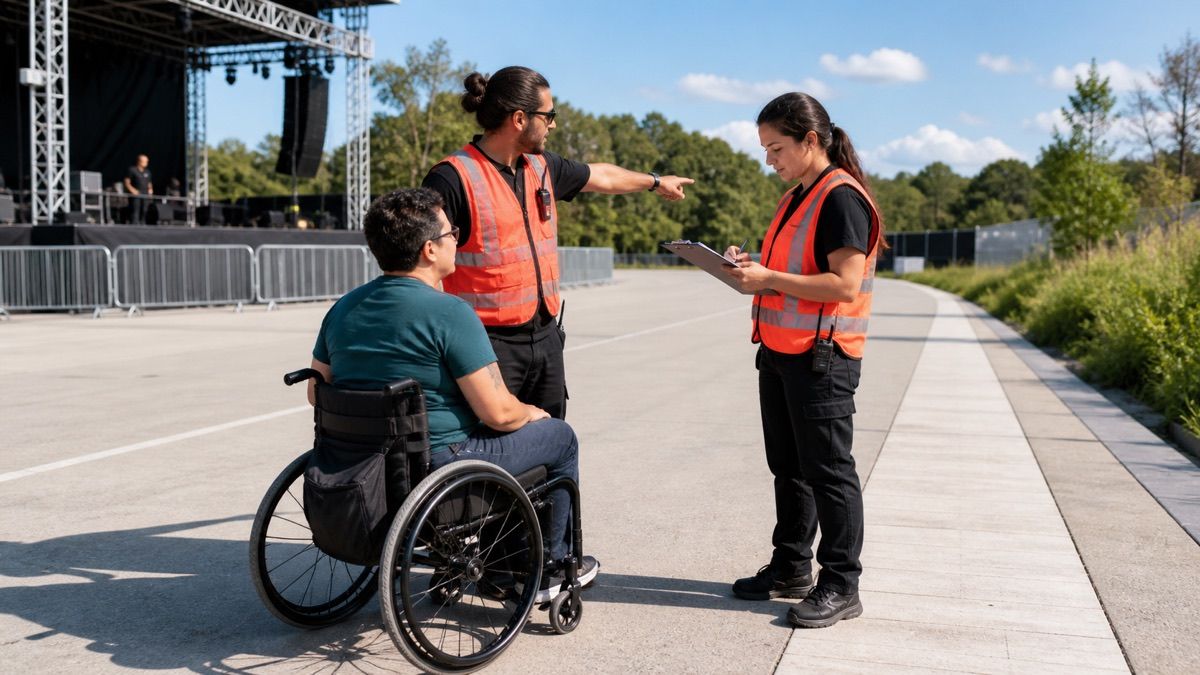
The authority to order movement is incomplete without current route evidence. Zone teams should report whether exits are open, paths are usable, counterflow is controlled, assembly areas remain safe and planned assistance is available.
The Home Office guidance for places of assembly highlights clear escape routes, assigned duties, arrangements for people needing assistance and planning for people after they leave. These are operational dependencies, not checklist decoration.
Link this decision system to WENOTIFT's guide on accessible evacuation assistance handoffs and the venue accessibility information guide. Do not treat a refuge or assistance request as proof that safe onward movement has been arranged.
Rehearse authority changes, not only ideal evacuation
A useful exercise introduces imperfect information: the commander is unavailable, a primary route closes, the public-address system fails, an attendee needs assistance, a contractor uses an old radio call or emergency services change the perimeter.
Observe decision latency, message consistency, acknowledged receipt, zone status and unresolved exceptions. These are internal learning measures, not universal safety benchmarks. The post-exercise review should assign owners and dates to changes in plans, maps, contact lists, training or equipment.
Use a short decision log
The live log should capture the minimum evidence needed to coordinate and learn without distracting command:
- timestamp and source of material information;
- current hazard and confidence;
- action, scope and authorising role;
- message version and channels;
- route or zone exceptions;
- next review point;
- change, cancellation or handover.
Protect personal and sensitive security information according to applicable law and organisational policy. The log is an operational record, not a place for speculative diagnoses or unnecessary attendee data.
Editor's decision test
Before opening, ask a deputy to answer five questions from the written plan: Who can call a partial evacuation? Who can widen it? What happens if that person is unreachable? Which channel carries the authoritative instruction? What evidence confirms the movement is complete? If the answers require interpretation, the authority system is unfinished.
Sources
- UK Home Office: Fire safety risk assessment—open-air events and venues
- UK Health and Safety Executive: Emergency procedures
- UK Home Office: Fire safety risk assessment—small and medium places of assembly
Turn an evacuation plan into an executable command system.
Talk to WENOTIFT about decision authority, communications, accessible handoffs and rehearsal for complex live events.